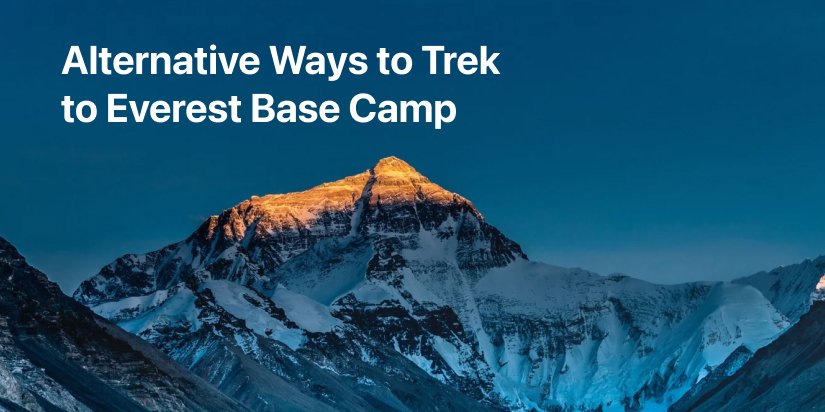
Besides the standard Lukla route, you can trek to Everest Base Camp via Gokyo and the Cho La pass, via the Jiri or Salleri trails with no flights at all, or add Renjo La and Kongma La for the full Three High Passes loop. Each option trades days, difficulty and cost for different scenery. Helicopter returns offer a faster way home for trekkers who are short on time.
The classic route from Lukla to Base Camp and back is popular for good reason: it is well supported, well mapped and fits into about 12 to 14 days. But it is also busy, it retraces the same path on the way down and it depends on one of the world’s most weather-sensitive flights.
If you want a different experience of the Khumbu, there are several well-established alternatives. This guide compares them side by side, so you can see what each route adds, what it skips and who it suits. For a detailed look at the standard trail itself, see our Everest Base Camp route map and elevation guide.
In this guide
- Everest Base Camp Route Options Compared
- Trekking to Everest Base Camp Without Flying to Lukla
- The Jiri Trail: The Original Everest Approach
- The Salleri and Phaplu Road Approach
- The Gokyo Lakes and Cho La Route
- The Three High Passes Circuit
- Helicopter Options on the Everest Trek
- Permits for Alternative Routes
- Which Alternative Route Is Right for You?
- Frequently Asked Questions
- Plan Your Route to Everest Base Camp
Everest Base Camp Route Options Compared
The table below summarises the main ways to reach Everest Base Camp. Days include acclimatisation but not international arrival and departure days in Kathmandu. Costs are indicative for a guided trek in the 2025 to 2026 seasons and vary a lot with group size, lodge standard and season.
| Route | Days | Max altitude | Difficulty | Indicative cost vs classic | Skipped / added | Best for |
|---|---|---|---|---|---|---|
| Classic Lukla route | 12 to 14 | 5,545 m (Kala Patthar) | Moderate to challenging | Baseline | – | First-timers with limited time |
| Jiri trail (no flight in) | 18 to 21 | 5,545 m (Kala Patthar) | Challenging, very long | Similar or slightly higher (more days, no inbound flight) | Skips Lukla flight; adds the lower hills, Lamjura La and Sherpa villages | Trekkers with time who want the historic approach |
| Salleri or Phaplu road plus trek | 15 to 18 | 5,545 m (Kala Patthar) | Challenging | Similar (jeep instead of flight, extra days) | Skips Lukla flight; adds 2 to 4 days of lower trail | Avoiding flight delays, especially in shoulder seasons |
| Gokyo Lakes and Cho La to EBC | 15 to 18 | 5,545 m (Kala Patthar); Cho La 5,420 m | Challenging, with glacier crossing | Higher (3 to 5 extra days) | Adds Gokyo Lakes, Gokyo Ri and Cho La | Fit trekkers wanting a loop and fewer crowds |
| Three High Passes circuit | 18 to 21 | 5,545 m (Kala Patthar); Kongma La 5,535 m | Strenuous | Highest (6 to 8 extra days) | Adds Renjo La, Cho La, Kongma La, Gokyo and Chhukung | Experienced high-altitude trekkers |
| Classic trek with helicopter return | 9 to 11 | 5,545 m (Kala Patthar) | Moderate to challenging | Higher (helicopter cost) | Skips the 3 to 4 day walk back to Lukla | Trekkers short on time |
Trekking to Everest Base Camp Without Flying to Lukla
The Lukla flight is the most unpredictable part of any Everest trek. Cloud, wind or rain can ground flights for days, and some travellers simply prefer not to fly into one of the world’s most famous mountain airstrips. The good news is that you can reach the Khumbu entirely overland.
There are two main ways to do this. The historic option is to trek from Jiri, which follows the traditional walk-in used by early Everest expeditions before Lukla airport was built in 1964. The more modern option is to take a jeep to a roadhead in the lower Solukhumbu, such as Salleri, Phaplu or further up the valley, and walk from there to join the main trail below Lukla.
Either way, you arrive on the classic route around Surke, Chaurikharka or Chheplung and continue to Phakding and Namche as normal. You can then return the same way or fly out from Lukla if you prefer a quicker finish.
The Jiri Trail: The Original Everest Approach
Jiri (1,905 m) is a small town east of Kathmandu, reached by a seven to nine hour bus or jeep ride. From there, the trail climbs over a series of ridges and valleys, passing through villages such as Shivalaya, Bhandar, Sete, Junbesi, Nuntala and Kharikhola before joining the main Everest trail below Lukla.
Walking from Jiri to the Lukla area typically takes six to seven days. Highlights include the Lamjura La pass (around 3,530 m) with its rhododendron forests, the beautiful Sherpa village of Junbesi and the Thubten Chholing monastery nearby. You also get a much more gradual acclimatisation, because you spend almost a week between 1,500 and 3,500 metres before reaching Namche.
The downside is time and effort. The Jiri trail involves many long climbs and descents, adding thousands of metres of total ascent, and it roughly doubles the length of the trek. Teahouses are simpler and fewer than on the main trail. In the monsoon, this lower route is also muddy, leech-heavy and more exposed to landslides.
The Salleri and Phaplu Road Approach
Roads have steadily pushed deeper into the Solukhumbu in recent years. Today, jeeps from Kathmandu reach Salleri and Phaplu in around 10 to 12 hours, and seasonal tracks continue further north towards Kharikhola and Thamdanda. From these roadheads, trekkers walk for two to four days to join the main Everest trail.
This option is popular with trekkers and guides who want to avoid the risk of flight delays, especially in shoulder seasons when Lukla flights are less reliable. It is also cheaper than flying, although the long, bumpy jeep ride is tiring.
Road conditions change quickly, especially after the monsoon, so the exact roadhead and travel time can vary from season to season. A local operator can advise you on current conditions before you commit to this approach.
The Gokyo Lakes and Cho La Route
The Gokyo route is one of the most rewarding alternatives to the classic trek. Instead of heading straight from Namche to Tengboche, you turn north-west up the Dudh Koshi valley through Dole and Machhermo to Gokyo (4,790 m), a small village beside a chain of turquoise glacial lakes.
From Gokyo, most trekkers climb Gokyo Ri (5,357 m), which offers one of the finest panoramas in Nepal, including Everest, Lhotse, Makalu and Cho Oyu. The route then crosses the Ngozumpa Glacier to Thangnak (Dragnag) and climbs over the Cho La pass (5,420 m) to Dzongla, before joining the classic trail near Lobuche and continuing to Gorak Shep and Base Camp.
This route adds around three to five days to the classic trek and involves a demanding pass crossing, often with snow and ice on the Cho La glacier. In return, you get quieter trails, a loop instead of an out-and-back route and arguably better views than Kala Patthar itself.
The Three High Passes Circuit
The Three High Passes trek is the ultimate Everest region adventure for experienced trekkers. It links Renjo La (5,360 m), Cho La (5,420 m) and Kongma La (5,535 m) in a grand loop that takes in Thame, Gokyo, Everest Base Camp and Chhukung.
The full circuit usually takes 18 to 21 days and involves several very long, high days above 5,000 metres. Kongma La, between Chhukung and Lobuche, is generally considered the hardest of the three passes. Many trekkers choose to cross only one or two passes, depending on their time and fitness.
For a full breakdown of each pass, including difficulty, conditions and best seasons, read our dedicated guide to the high passes on the Everest Base Camp trek.
Helicopter Options on the Everest Trek
Helicopters play a growing role on the Everest trail. The most popular option is to trek up to Base Camp and Kala Patthar on foot, then fly back from Gorak Shep or Pheriche to Lukla or Kathmandu. This cuts three to four days of walking from the return journey and shortens the whole trip to around 9 to 11 days.
Costs vary with season, fuel prices and how many seats are filled. As a rough guide, a shared seat on a helicopter from Gorak Shep to Kathmandu often costs somewhere around USD 500 to 1,200 per person, while a private charter for the whole aircraft can cost USD 3,500 to 5,000 or more. Shared helicopter seats between Lukla and Ramechhap or Kathmandu are also sold when fixed-wing flights are grounded.
Weather still matters. Helicopters can fly in slightly worse conditions than planes, but they also need reasonable visibility. Remember too that a helicopter return means you descend very quickly, so you miss some of the gradual walking descent many trekkers enjoy.
Permits for Alternative Routes
The core permits are the same whichever route you choose. You need the Khumbu Pasang Lhamu Rural Municipality entry permit, collected at Lukla or at the checkpoint where you enter the Khumbu on foot, and the Sagarmatha National Park permit, checked at Monjo.
If you start from Jiri, you may also need a Gaurishankar Conservation Area permit for the first part of the route. Requirements are sometimes updated, so always check the latest rules with a registered trekking agency or the Nepal Tourism Board before you set off.
Which Alternative Route Is Right for You?
If you want to avoid the Lukla flight and have plenty of time, the Jiri trail offers a slow, beautiful and culturally rich approach. If you prefer a shorter overland option, a jeep to the Solukhumbu roadheads is a practical compromise.
If your goal is better views and quieter trails, the Gokyo Lakes and Cho La route is hard to beat, as long as you are fit and comfortable with a demanding pass crossing. Experienced trekkers with three weeks to spare can take on the Three High Passes for the most complete experience of the Khumbu.
Finally, if time is tight, a helicopter return lets you complete the classic trek to Base Camp without the long walk back. Whichever you choose, timing matters: see our guide to the best time to trek to Everest Base Camp, and note that lower-altitude routes like Jiri are particularly tough during the monsoon season.
Frequently Asked Questions
Can you trek to Everest Base Camp without flying to Lukla?
Yes. You can trek from Jiri, the historic starting point, in about six to seven days to the Lukla area, or take a jeep to Salleri, Phaplu or a roadhead further north and walk two to four days to join the main trail. Both options remove the risk of inbound flight delays.
What is the Everest Base Camp trek via Gokyo?
It is a loop route that visits the Gokyo Lakes and Gokyo Ri (5,357 m) before crossing the Cho La pass (5,420 m) to join the classic trail near Lobuche. It usually takes 15 to 18 days and offers quieter trails and outstanding mountain views.
What is the Three High Passes trek route?
The Three High Passes trek crosses Renjo La (5,360 m), Cho La (5,420 m) and Kongma La (5,535 m) in a loop through Thame, Gokyo, Everest Base Camp and Chhukung. It takes around 18 to 21 days and is suited to fit, experienced high-altitude trekkers.
How much does an Everest Base Camp helicopter option cost?
As a rough guide, a shared helicopter seat from Gorak Shep to Kathmandu often costs around USD 500 to 1,200 per person, while a private charter can cost USD 3,500 to 5,000 or more. Prices depend on season, fuel costs and how many passengers share the flight.
Is the Gokyo route harder than the classic EBC trek?
Yes, somewhat. The Gokyo and Cho La route is longer and includes a high pass with a glacier crossing, which can be icy and requires good fitness and sometimes microspikes. However, it also offers more gradual acclimatisation and less crowded trails.
Plan Your Route to Everest Base Camp
Choosing the right route is about balancing time, fitness and the kind of experience you want. Explore our Everest Base Camp trek for itineraries and planning guides, and contact Zeal Nepal Trek to design a guided trek via Jiri, Gokyo, the high passes or with a helicopter return.