Overview
Langtang Valley Trek
Langtang Valley is the closest Himalayan trekking region to Kathmandu, and it’s the one most trekkers underestimate. Within a week you can walk from subtropical river gorges through rhododendron and bamboo forest, past glacial moraine, into a high Tibetan-influenced valley ringed by 7,000-metre peaks — without ever boarding a domestic flight. This guide covers the full 8-day itinerary, honest costs, current permit and guide rules for 2026, safety information, and every question a first-time Langtang trekker actually asks.
Is Langtang Valley Trek worth it?
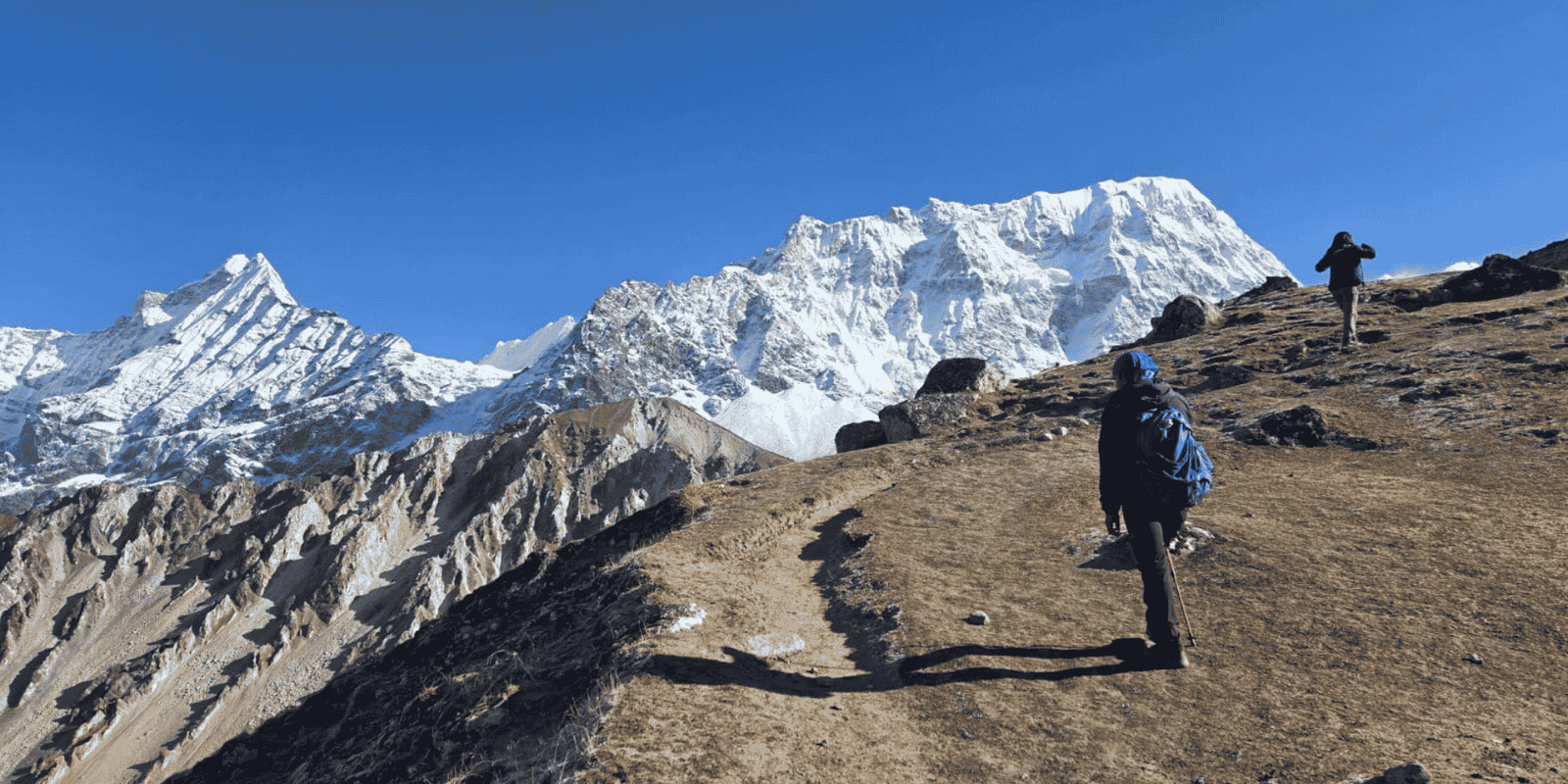
Yes — and for a specific kind of trekker. Langtang rewards people who want genuine Himalayan scenery and culture without the six-figure crowds of Everest Base Camp or the three-week commitment of the Annapurna Circuit. You get Tamang villages instead of espresso bars, a national park with red pandas and blue sheep instead of yak-jam traffic on the trail, and summit views of Langtang Lirung (7,227 m) that rival anything in the Khumbu — all reachable by an 7–8 hour jeep ride rather than a weather-dependent mountain flight.
It’s also the trek that best demonstrates Nepal’s recovery. The 2015 earthquake and the avalanche it triggered devastated Langtang Village, and the region’s slower return to the trekking map means trails are quieter and communities more directly dependent on — and grateful for — every trekker who comes back. If you’re deciding between Langtang and a better-known alternative, the honest comparison is below in the “Langtang vs. Everest vs. Annapurna” section.
Langtang is not the right choice if you specifically want an 8,000 m base camp view (Everest, not Langtang) or a high mountain pass crossing as your main objective (Annapurna Circuit or Langtang’s own Ganja La Pass extension). For everyone else — first-time Himalayan trekkers, families, people with 8–10 days rather than 3 weeks, and travelers who want culture alongside scenery — Langtang is very much worth it.
Route Map & Elevation Profile
The standard route follows the Langtang Khola (river) valley east from Syabrubesi to its glacial source below Langtang Lirung, then retraces the same trail back. There is no full loop option on the classic itinerary, though a Sherpa Gaun/Khangjim variant on the return leg offers a partial alternate path (see Route Variants below).
|
Day |
Route |
Distance |
Elevation |
Walking time |
|
1 |
Kathmandu → Syabrubesi |
~122 km (drive) |
1,410 → 1,467 m |
7–8 hrs drive |
|
2 |
Syabrubesi → Lama Hotel |
~11 km |
1,467 → 2,470 m |
6–7 hrs |
|
3 |
Lama Hotel → Langtang Village |
~12 km |
2,470 → 3,430 m |
6–7 hrs |
|
4 |
Langtang Village → Kyanjin Gompa |
~8 km |
3,430 → 3,870 m |
3–4 hrs |
|
5 |
Acclimatization day (Kyanjin Ri or Tserko Ri hike) |
~4–10 km optional |
up to 4,600–4,984 m |
3–7 hrs optional |
|
6 |
Kyanjin Gompa → Lama Hotel |
~19 km |
3,870 → 2,470 m |
6–7 hrs |
|
7 |
Lama Hotel → Syabrubesi |
~11 km |
2,470 → 1,467 m |
5–6 hrs |
|
8 |
Syabrubesi → Kathmandu |
~122 km (drive) |
1,467 → 1,410 m |
7–8 hrs drive |
Total trekking distance is roughly 65 km, spread across five walking days, with two full driving days bookending the trip. The steepest single climb is Day 2 (Syabrubesi to Lama Hotel), which gains just over 1,000 m — this is the day most first-timers find hardest, not the higher-altitude days that follow.
Difficulty, Fitness & a 6-Week Training Plan
Langtang is graded moderate — harder than the Poon Hill or Ghorepani short treks, easier than Everest Base Camp or the Annapurna Circuit. You don’t need mountaineering experience or technical skill. You do need the cardiovascular base to walk 5–7 hours a day, for five consecutive days, on uneven ground, at altitude.
What makes it moderate rather than easy:
-
Daily walking of 5–7 hours, several days back-to-back with limited rest
-
A maximum altitude of 3,870 m at the overnight stop (optional hikes push higher, to 4,600–4,984 m)
-
Steep, sustained climbs on Days 2 and 3, including stone steps and loose scree in places
-
Basic teahouse conditions — shared bathrooms are common above Lama Hotel, and heating is limited to the dining hall
Six-week fitness plan, if you’re starting from a normal (non-athlete) fitness base:
-
Weeks 1–2: Build a walking base — 45–60 minute brisk walks or hikes, 4x/week, ideally with some elevation gain. Add two short strength sessions focused on legs, glutes and core.
-
Weeks 3–4: Increase to 2–3 hour hikes on weekends, ideally with a loaded daypack (6–8 kg) to simulate trail conditions. Continue strength training and add stair climbing or a step machine.
-
Weeks 5–6: One long hike (4+ hours) with a loaded pack, plus continued shorter sessions. Taper the final week before departure so you arrive rested, not fatigued.
If you can comfortably complete a 4-hour hike with 800 m of elevation gain while carrying a daypack, you are fit enough for Langtang. Age is rarely a limiting factor on this trek — we regularly guide trekkers in their 60s and 70s, and it’s one of the more realistic Himalayan treks for families with children aged 10 and up, given the shorter daily distances and lower maximum altitude than Everest or Annapurna routes.
Best Time to Trek Langtang Valley
Autumn (late September–November) is the single best window: post-monsoon skies are at their clearest, temperatures at altitude are comfortable (5–15°C by day, dropping below freezing at night above 3,000 m), and mountain visibility is near-guaranteed. This is peak season — book teahouses and guides in advance.
Spring (March–May) is a close second, and arguably better for rhododendron forests, which bloom vividly on the lower trail sections in March–April. Daytime temperatures are similar to autumn; afternoon haze can occasionally soften long-distance mountain views, though close-range scenery (Langtang Lirung, Kyanjin valley) remains spectacular.
Winter (December–February) is viable and increasingly popular for trekkers who want a quiet trail — expect very few other trekkers, crisp clear mornings, and cold nights (routinely -10°C to -15°C at Kyanjin Gompa). Some higher teahouses reduce services or close in January; a good outfitter will confirm availability before you commit to winter dates.
Monsoon (June–early September) is not recommended. Daily rain brings leech-heavy trails, landslide risk on the exposed sections between Syabrubesi and Lama Hotel, and persistent cloud cover that hides the mountains you came to see.
Langtang National Park: Wildlife, Flora & the “Valley of Glaciers”
Established in 1976, Langtang National Park covers 1,710 sq km (with a 420 sq km buffer zone), making it one of Nepal’s earliest protected areas and the closest Himalayan national park to Kathmandu. The park earns its nickname — the Valley of Glaciers — from the dense concentration of glacial systems feeding the Langtang Khola, including the glaciers draining off Langtang Lirung, Langshisa, and the Ganja La ridge.
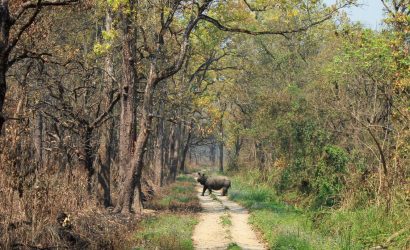
The trail moves through several distinct ecological zones in a single week: subtropical forest near Syabrubesi, temperate broadleaf and bamboo forest through the Lama Hotel stretch (prime red panda habitat), rhododendron and hemlock forest approaching Langtang Village, and alpine scrub and pasture beyond the treeline near Kyanjin Gompa. The park is home to red pandas, Himalayan black bears, musk deer, and — at higher elevations — blue sheep (bharal) and, rarely, snow leopard. Birdlife is notably rich, with over 250 recorded species including the Himalayan monal, Nepal’s national bird.
Tamang & Sherpa Culture, Monasteries and Village Life
More than 80% of the population in the Langtang region is ethnically Tamang, with a distinct language, dress, and Tibetan Buddhist religious tradition — the Tamang trace ancestral and cultural links across the Tibetan plateau, reflected in the prayer flags, mani walls, and chortens that line the trail from Langtang Village upward. Kyanjin Gompa, the valley’s spiritual center, houses a monastery dating back centuries, and remains an active site of worship rather than a museum piece.
Village life along the trail is still substantially subsistence-based — potatoes, buckwheat, and yak herding — supplemented increasingly by tourism income, especially since the earthquake rebuilding. Trekkers who take time to sit in a teahouse dining hall, ask questions, and engage respectfully with lodge owners consistently describe this cultural contact as the most memorable part of the trek, more than the mountain views themselves.
Langtang Valley after the 2015 Earthquake
On 25 April 2015, the magnitude 7.8 Gorkha earthquake triggered a massive avalanche off Langtang Lirung that swept directly through Langtang Village, killing roughly 175 residents and visiting trekkers and destroying the settlement almost completely — one of the single deadliest incidents of the entire disaster. It remains the most significant event in the region’s modern history, and it shapes the landscape you’ll walk through: the trail above Langtang Village crosses the debris field, and the rebuilt village sits slightly apart from the original site.
The community’s recovery has been steady rather than fast. Langtang Village, Mundu, and Kyanjin Gompa have been rebuilt with sturdier construction, and the flow of trekkers returning to the valley is directly tied to household income across the region. Choosing to trek Langtang — rather than defaulting to Everest or Annapurna — is a meaningful, practical way to support that recovery; guides, porters, and lodge owners in this region will tell you so directly, without you needing to ask.
Permits, TIMS Card & Do You Need a Guide?
This is the question with the most conflicting information online, so here’s the current, dated answer: a licensed guide has been mandatory for all foreign trekkers in Nepal’s trekking regions, including Langtang, since April 2023, a rule introduced jointly by the Nepal Tourism Board and the Trekking Agencies’ Association of Nepal (TAAN). It remains fully enforced in 2026 — solo trekkers without a guide are turned back at the Syabrubesi checkpoint. This closed the long-standing “independent trekking” option that older blog posts and outdated guides still reference.
Every foreign trekker also needs the Langtang National Park Entry Permit (NPR 3,000, roughly $23, for non-SAARC foreign nationals; discounted for SAARC nationals), checked at the park entrance near Dhunche/Syabrubesi. TIMS card requirements have shifted since the 2023 policy change and vary by how your permits are bundled — in practice this no longer matters to you as a trekker, because a licensed agency arranges whichever combination of permits currently applies as part of your booking. The only thing to confirm with any operator is that all required permits are included in your quoted price, with no separate “permit processing” surprise fee at the end.
Full Cost Breakdown
Costs vary by group size, season, and what’s included, but here’s a realistic breakdown for an 8-day guided package:
|
Item |
Typical cost (USD) |
|
Guided 8-day package (per person, group of 2–8) |
$765 |
|
Langtang National Park Permit |
~$23 (NPR 3,000) |
|
Kathmandu–Syabrubesi–Kathmandu transport |
Usually included in package |
|
Teahouse accommodation (7 nights) |
Usually included in package |
|
Meals (breakfast, lunch, dinner) |
Usually included in package |
|
Licensed guide |
Usually included in package |
|
Porter (optional, shared between 2 trekkers) |
$20–$25/day, or ~$150–$190 for the trip |
|
Travel & rescue insurance |
Not included — budget $60–$150 depending on provider and coverage to 5,000m |
|
Personal expenses (snacks, hot showers, charging, Wi-Fi, bottled/boiled water) |
$10–$20/day |
|
Tips for guide and porter |
$8–$12/day per trekker is a reasonable norm |
Independent budget estimate (if trekking with a guide but arranging accommodation/meals pay-as-you-go rather than a fixed package): expect roughly $30–$45 per day for teahouse lodging and food, plus guide fees of $25–$35/day, plus the permit and transport costs above. For most travelers, a fixed package removes the daily-negotiation hassle and isn’t meaningfully more expensive once guide fees, permits, and transport are accounted for individually.
Accommodation & Teahouses Along the Route
Accommodation throughout is in teahouses — family-run lodges offering twin-share rooms with basic bedding (bring or rent your own sleeping bag). Rooms below Lama Hotel occasionally have attached bathrooms; above that, shared squat or Western-style toilets down the hall are standard. Every teahouse has a communal dining hall, usually heated in the evening by a central wood or dung-fired stove — this room is the social and practical heart of the trek, where meals, charging, and conversation with other trekkers all happen. Rooms themselves are unheated; a good sleeping bag (rated to at least -10°C for higher stops) matters more than the room itself. During peak season (October–November, March–April), book ahead through your operator, particularly for Kyanjin Gompa, where capacity is more limited than lower villages.
Food, Water & Hydration
Teahouse menus are broadly consistent trail-wide: dal bhat (lentils, rice, vegetable curry, often with unlimited refills) is the standard, filling, and most reliably fresh option, alongside momos, noodle dishes (chowmein, thukpa), soups, and simple Western options like porridge, eggs, and pancakes. Above Langtang Village, ingredient variety narrows and prices rise slightly to reflect the cost of portering supplies uphill.
Hydration matters more at altitude than people expect — aim for 3.5–4 litres of water daily. Boiled water is available at every teahouse for a small fee (cheaper and more sustainable than bottled water, which also means fewer plastic bottles carried out of a fragile alpine environment); bring a reusable bottle and water purification tablets or a filter as backup. Avoid alcohol above Lama Hotel — it worsens dehydration and masks early symptoms of altitude sickness — and go easy on meat dishes at higher elevations, where refrigeration and fresh supply are less reliable.
Dietary restrictions and allergies: vegetarian and vegan diets are easily accommodated (dal bhat is naturally vegetarian, and vegan on request). Gluten-free options are limited but possible with advance notice to your guide, who can flag your requirements to teahouse kitchens along the route. Let your operator know before departure so this is arranged, not improvised on the trail.
Altitude Sickness, Safety & Emergency Evacuation
Langtang’s maximum overnight altitude (3,870 m) is meaningfully lower than Everest Base Camp (5,364 m) or the Annapurna Circuit’s Thorong La crossing (5,416 m), which makes Acute Mountain Sickness (AMS) less common — but not impossible, especially on the optional Tserko Ri hike to nearly 5,000 m. Standard precautions apply: ascend gradually (the itinerary above is paced correctly for this), drink 3.5–4 litres of water daily, avoid alcohol above 2,500 m, and know the early symptoms — headache, nausea, dizziness, loss of appetite — which mean stop ascending and tell your guide immediately, not push through.
High-risk trail sections: the Syabrubesi–Lama Hotel stretch crosses landslide-prone terrain in a few sections, particularly during or after heavy rain; your guide will know current trail conditions. Give way to loaded mule and yak trains by stepping to the inside (uphill) edge of the trail, never the outer drop-off side.
Emergency evacuation: the upper valley has no road access, so serious medical emergencies are evacuated by helicopter from Kyanjin Gompa or Lama Hotel, coordinated by your guide with your agency’s Kathmandu office. This is precisely why travel insurance with high-altitude helicopter evacuation coverage (to at least 5,000 m) is non-negotiable — confirm your policy explicitly covers this before you fly to Nepal, not after you need it.
Who should trek carefully or reconsider: trekkers with pre-existing heart or lung conditions should get medical clearance before booking. Pregnant trekkers should consult a doctor given the altitude and physical demands. There is no strict upper age limit — fitness matters more than age — but anyone with limited hiking experience should do the six-week training plan above seriously, not casually.
Responsible & Sustainable Trekking
Langtang’s alpine ecosystem is fragile and recovering. Practical ways to trek responsibly: use a reusable bottle with purification tablets or a filter instead of buying bottled water at altitude; pack out non-biodegradable waste (batteries, wrappers, hygiene products) rather than assuming it will be handled locally; ask before photographing residents or entering private property; walk mani walls and chortens with them on your right, in keeping with Buddhist tradition; and where possible, choose locally owned teahouses and buy directly from village producers (like Kyanjin’s yak cheese) over imported packaged goods. Supporting a region still rebuilding from 2015 is not incidental to the trek — for many operators and communities here, it’s the point.
Langtang vs. Everest Base Camp vs. Annapurna Circuit vs. Annapurna Base Camp
|
|
Langtang Valley |
Everest Base Camp |
Annapurna Circuit |
Annapurna Base Camp |
|
Duration |
8 days |
12–14 days |
15–20 days |
7–9 days |
|
Max altitude |
3,870 m (4,984 m optional) |
5,364 m |
5,416 m (Thorong La) |
4,130 m |
|
Access from Kathmandu |
7–8 hr drive |
Flight to Lukla (weather-dependent) |
Drive + trek |
Drive to Pokhara/Nayapul |
|
Crowd level |
Low–moderate |
Very high |
Moderate–high |
High |
|
Approx. cost (guided) |
$765 |
$1,300–$1,800 |
$1,000–$1,500 |
$700–$1,000 |
|
Best for |
First-timers, families, limited time, culture + scenery |
Iconic Everest views, bucket-list trekkers |
Pass-crossing, longest classic trek |
Amphitheater mountain views, moderate difficulty |
Langtang is the shortest, most accessible, and most affordable of Nepal’s major teahouse treks, without meaningfully compromising on scenery or cultural depth — the trade-off is that you don’t stand at the foot of an 8,000 m peak, which EBC delivers and Langtang does not.
Who Should Trek Langtang? (And Who Should Wait)
Good fit: first-time Himalayan trekkers, families with children 10+, travelers with 8–10 days rather than 3 weeks, budget-conscious trekkers, anyone who wants strong cultural contact alongside mountain scenery, photographers who want fewer crowds in their shots than EBC delivers.
Solo female travelers: Langtang is a realistic and well-traveled choice — the mandatory guide requirement (see Permits section) means you won’t be trekking genuinely alone, and reputable agencies can match female trekkers with female guides on request. Standard precautions apply: share your daily itinerary with someone at home, keep your guide informed of your plans, and trust your judgment on teahouse choices in less-trafficked stretches.
Should wait or seek medical clearance first: trekkers with uncontrolled heart or lung conditions, anyone who has had a serious AMS episode on a previous trek without addressing it medically, and pregnant travelers (consult your doctor). None of these are automatic disqualifiers — they’re reasons to get a professional opinion before booking, not after arriving in Kathmandu.