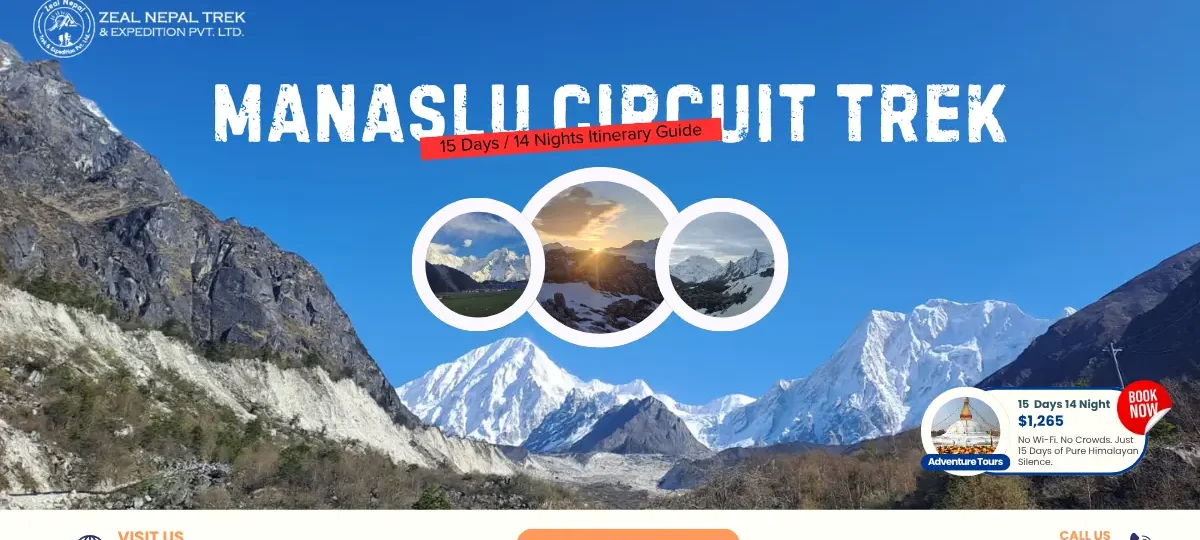
Manaslu Circuit Trek isn’t a walk in the park with better views. Most trekking blogs make the Manaslu Circuit sound like a walk in the park with better views. It’s not. And that’s exactly why you should do it.
This guide won’t sell you fairy tales. It’ll tell you what 15 days on this trail actually look like. The good. The tough. And the absolutely unforgettable. If you’re the kind of person who wants to know what you’re signing up for before you book, keep reading.
Why Manaslu? And Why Not Everest or Annapurna

Everest Base Camp sees over 40,000 trekkers a year. Annapurna Circuit is packed with teahouses, lodges, and fellow trekkers around every bend.
Manaslu sees about 2,000 trekkers annually. That’s it.
The Manaslu Circuit is a restricted area trek. You need special permits. You need a guide. The government keeps numbers low on purpose to protect the culture, the environment, and the experience itself.
What you get in return: trails where you might walk for hours without seeing another foreigner. Villages where Tibetan culture hasn’t been scrubbed clean for tourist consumption. And a 5,340-meter pass that rewards you with a 360-degree view of eight Himalayan giants, including the eighth-highest mountain on Earth.
Manaslu Circuit Trek Difficulty
The Manaslu Circuit Trek is rated moderate to challenging. Let’s translate that into plain English.
You’re walking 6 to 8 hours a day for 12 days straight. On the pass day, it’s 8 to 10 hours. The terrain is rocky, steep in sections, and includes something Nepali guides call “Nepali Flat” which is never actually flat. It’s constant up and down.
The altitude is the real challenge. You sleep above 3,000 meters for multiple nights. You cross a pass at 5,340 meters. As you climb above 3,000 meters, atmospheric pressure drops, reducing the density of available oxygen per breath. Altitude sickness is a genuine risk.
Here’s the good news: you don’t need to be an athlete. You need to be fit enough to walk 7 to 8 hours a day with a daypack, smart enough to respect the altitude, and stubborn enough to keep going when your legs are tired.
The itinerary includes two full acclimatization days, one at Samga Gwan and one at Samdo. That’s not padding. That’s how you stay safe.
Manaslu Circuit Trek Permits
You can’t just show up and start walking. The Manaslu region requires three permits, and they must be processed through a registered trekking agency.
1. Manaslu Restricted Area Permit (RAP)
This permit is required from Jagat until you cross Samagaun. The cost varies by season:
- Peak season (September to November): USD 100 per person for the first seven days, plus USD 15 per additional day.
- Off season (December to August): USD 75 per person for the first seven days, plus USD 10 per additional day.
2. Manaslu Conservation Area Permit (MCAP)
This permit costs approximately USD 30 per person (NPR 3,000 for foreign nationals). It has no time limit and supports conservation efforts in the region.
3. Annapurna Conservation Area Permit (ACAP)
Since the trail exits through the Annapurna region, you’ll also need this permit at approximately USD 30 per person.
Total permit cost for a 15-day trek during peak season typically ranges from USD 175 to 244 per person.
Independent trekkers are not allowed on this route. Permits can only be obtained through a registered trekking agency in Nepal.
When to Go: Best Time for the Manaslu Circuit Trek
Autumn (September to November) is the undisputed king. Clear skies. Stable weather. The best visibility for mountain views. Temperatures range from 0°C to 18°C. October is the single best month.
Spring (March to May) is the runner-up. Warmer days, blooming rhododendrons, and still decent visibility. April and early May are your sweet spots.
Skip summer (June to August). That’s monsoon. Rain, landslides, leeches. The pass can be dangerous. Winter (December to February) is doable but brutally cold, with snow on the pass.
The 15-Day Itinerary: How to Prepare for the Manaslu Circuit Trek?
Day 1: Kathmandu to Soli Khola (700m). Drive time: 7 to 7.5 hours. Early start, long road, arrive by late afternoon.
Day 2: Soli Khola to Machha Khola (930m). First walking day. Eight hours. Gentle trails along the river.
Day 3: Machha Khola to Jagat (1,340m). Seven hours. Up and down, hot springs at Taptonai, enter conservation area.
Day 4: Jagat to Deng (1,860m). Six hours. Suspension bridges, bamboo forests, trail split at Bile Batti.
Day 5: Deng to Namung (2,630m). Six hours. Tibetan influence: mani walls, chortens, prayer flags.
Day 6: Namung to Ho (3,180m). Four hours. Altitude crosses 3,000m. Monasteries and stunning landscapes.
Day 7: Ho to Samga Gwan (3,530m). Four hours. Highest village in the valley. Watch for altitude symptoms.
Day 8: Acclimatization. Hike to Ngompa Monastery, Kharka village, Blennda Lake, and Manaslu Base Camp viewpoint. Descend to sleep.
Day 9: Samga Gwan to Samdo (3,865m). Four hours. Windy. Yak chains on the path. Tibetan border feels close.
Day 10: Acclimatization. Hike towards Tibetan border (~5,100m), descend back to Samdo to sleep.
Day 11: Samdo to Dharmasala (4,460m). Four hours. Foot of Larkya La. Basic lodge, early rest.
Day 12: Dharmasala → Larkya La Pass (5,340m) → Bimthang (3,590m). Nine hours. Start at 4:30 AM. Summit views of Manaslu, Annapurna, and a dozen other peaks. Descent to Bimthang.
Day 13: Bimthang to Tilje (2,234m). Six hours. Rhododendron forests, cross Dukh Kashi river, Gurung village.
Day 14: Tilje to Jagat (1,400m). Five and a half hours. Last walking day. Scenic descent.
Day 15: Jagat to Kathmandu. Long drive back. Tired, dirty, and already planning the next one.
What to Pack: The Short List
- Layered clothing: thermal base layer, fleece, down jacket, waterproof shell
- Trekking boots: broken in, waterproof
- Sleeping bag: rated for -10°C to -15°C
- Trekking poles: your knees will thank you
- Headlamp: with extra batteries
- Sunscreen and sunglasses: the sun at altitude is brutal
- Water bottles: 2 to 3 liters capacity
- First aid kit: include basic meds for pain, cold, stomach issues
Most items can be rented or bought in Kathmandu if you forget something.
Manaslu vs Annapurna: Which One?
Manaslu Circuit Trek and Annapurna Base Camp Trek, both circuits take you over a 5,000-meter pass. Both are spectacular. But they’re completely different experiences.
Let’s break it down.
Altitude.
Manaslu tops out at 5,340 meters at Larkya La. Annapurna nudges slightly higher at 5,416 meters at Thorong La. That’s a difference of just 76 meters – your lungs won’t notice the difference, but the views from both are jaw-dropping.
Duration.
The Manaslu Circuit takes a full 15 days, start to finish. Annapurna can be wrapped up in 13 to 14 days. Not a huge gap, but if you’re squeezed for time, Annapurna gives you a little breathing room.
Crowds.
This is where the choice gets real. Manaslu sees about 2,000 trekkers a year. You’ll walk for hours without seeing another foreign face. Annapurna, on the other hand, is a highway. Teahouses are packed, trails are busy, and you’ll share almost every viewpoint with a dozen other trekkers.
Infrastructure.
Manaslu keeps it basic. You’ll sleep in simple lodges with limited electricity and hot water. It’s part of the charm. Annapurna has well-developed teahouses with better food, Wi-Fi, hot showers, and even bakeries in some villages.
Permit cost.
Manaslu hits your wallet harder because of the restricted area permit. You’re looking at roughly USD 175 to 244 for the full set of permits. Annapurna is significantly cheaper. You’ll pay around USD 50 to 70 for permits, and no restricted area fee.
So which one do you pick?
If you’re after solitude, raw Tibetan Buddhist culture, and a genuine sense of isolation, choose Manaslu. The trails are quieter, the villages feel less polished, and the pass crossing feels like a real achievement.
If you want better food, easier logistics, and don’t mind sharing the trail with other trekkers, Annapurna is the safer bet. It’s well-worn for a reason.
Both will give you a proper Himalayan experience. Just know what you’re signing up for.
Choose Manaslu if you want solitude, raw culture, and a genuine sense of adventure. Choose Annapurna if you prefer better infrastructure, easier logistics, and don’t mind sharing the trail.
The Guide Question: Why You Can’t Go Solo
The Manaslu Circuit traverses a restricted area. By law, you must trek with a licensed Nepali guide arranged through a registered trekking agency.
Permits are only issued to agency-registered trekkers. Solo independent trekking isn’t an option.
That’s not bureaucracy for bureaucracy’s sake. The restricted area status protects the culture, the environment, and, let’s be honest, you. Your guide must be government-certified with credentials verified by NATHM (Nepal Academy of Tourism and Hotel Management). One licensed guide can lead a maximum of seven trekkers.
The guide knows which sections are dangerous after rain, which teahouses are reliable, and when to push and when to turn back.
What You’ll Actually Spend
Beyond the permits, budget for:
- Teahouse accommodation: USD 5 to 15 per night
- Meals: USD 20 to 30 per day (dal bhat, noodles, eggs, and so on)
- Guide and porter fees: USD 25 to 40 per day for a guide, USD 15 to 25 for a porter
- Transport: USD 50 to 100 for the drive to and from Kathmandu
A fully guided package typically runs USD 1,000 to 1,500 for the full trek, depending on group size and inclusions.
The Bottom Line
The Manaslu Circuit isn’t the easiest trek in Nepal. It’s not the most luxurious. It’s not the one with the best Wi-Fi or the hottest showers.
What it is: one of the last genuinely wild, uncrowded, and culturally intact trekking routes in the Himalaya. A place where you can walk for hours and hear nothing but your own breathing and the river below. A 5,340-meter pass that will test you and reward you in equal measure.
If that sounds like your kind of adventure, here’s what to do next.
Meet your guide before you land in Nepal.
We’ll set up a video call with your assigned guide before you leave home. You’ll talk through the itinerary, ask questions about the trail, and know exactly who’s leading you across Larkya La. No surprises. No strangers showing up at the airport.
Limited 2026 departures available. Restricted area permits are capped, and slots fill months in advance.
Book your video call with your guide →
Your mountain is waiting. Let’s make sure you’re ready for it.