If Everest Base Camp (EBC) has been sitting quietly on your bucket list, 2026 might be the year you finally say yes.
You probably have watched a couple of YouTube vlogs. Checked the price once or twice. Maybe even imagined yourself standing beneath the prayer flags with the Khumbu icefall behind you.
And then you closed the tab. Because the real questions start creeping in:
- Is it worth the cost?
- How difficult is it really?
- When is the best time to go?
- Can beginners do it?
- Is it safe?
If Everest Base Camp has been quietly sitting in your head, 2026 might be the year you stop thinking and start moving.
This is not a glossy brochure guide. This is what you genuinely want to know.
Written from a trekker’s perspective, practical, honest, and experience-driven, this guide will help you decide whether Everest Base Camp is truly right for you in 2026.
What is Everest Base Camp really like?

You land in Kathmandu. You take a small plane to Lukla. Yes, that Lukla.
The Lukla Reality
The runway is 527 meters long and ends at a mountain wall. Then you start walking. Over the next 12–14 days, you’ll cover roughly 130 kilometers (about 80 miles) round trip from Lukla to Everest Base Camp and back. It doesn’t sound extreme on paper, but at high altitude, every kilometer feels different.
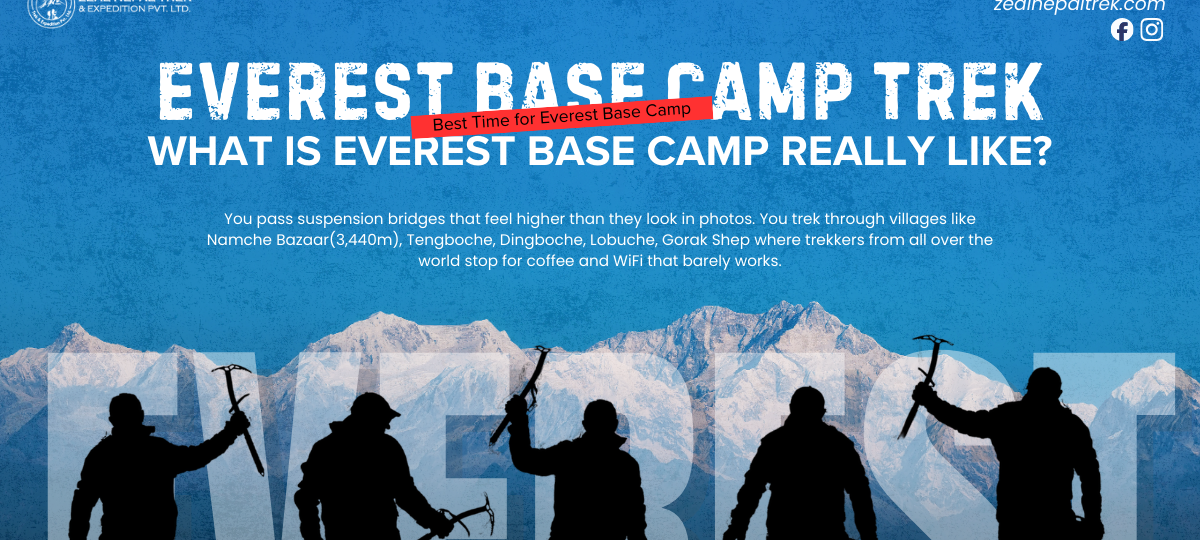
You pass suspension bridges that feel higher than they look in photos. You trek through villages like Namche Bazaar(3,440m), Tengboche, Dingboche, Lobuche, Gorak Shep where trekkers from all over the world stop for coffee and WiFi that barely works.
You wake up early in cold rooms. You drink more tea than you ever have in your life. And slowly, day by day, the mountains get bigger.
You do not climb Mount Everest. You trek to the base of it. The highest viewpoint of the trek is usually Kala Patthar(5,545m), where you get the classic panoramic view of Mount Everest. And when you finally stand at Everest Base Camp at 5,364 meters, you feel something that is hard to explain.
How hard is Everest Base Camp really?
This is the most searched question and for good reason. Now let’s remove the Instagram filter.
It is not technical. You do not need ropes. You do not need mountaineering experience. You can complete Everest Base Camp but it is tough.
The biggest challenge? Altitude above 4,500 meters.
You walk 5 to 7 hours most days, gaining several hundred meters in elevation as you move higher into thinner air. Above 4,000 meters your body starts negotiating with you. At 5,000 meters, your body is functioning with roughly 50% of the oxygen available at sea level. That’s why simple things like tying your boots or climbing a short incline suddenly feel harder than expected.
Some mornings feel heavy. Some nights feel cold. The last stretch to Kala Patthar can feel like slow motion. Altitude is the real challenge. Not distance.
At 5,000 meters, I remember stopping mid-step, breathing harder than I expected, and realizing this wasn’t about speed anymore, it was about patience.
If you train properly and pace yourself, most reasonably fit people can complete it. If you do not train and expect it to be a casual hike, it will humble you. That’s why proper acclimatization days are critical.
Best Time for Everest Base Camp 2026
Two main seasons.
Spring from March to May. Autumn from September to November.
Spring gives you clearer skies and the energy of Everest expeditions. Autumn gives you sharp mountain views and crisp air.
If you want balanced weather and classic views, April and October are usually ideal months.
But remember this. The mountain decides the final conditions, not your calendar.
Is Everest Base Camp worth the money?
This is what most people search for: Everest Base Camp cost 2026. You will see prices from around 1,100 dollars to over 3,000 dollars. What you are paying for is not just a bed and meals.
You are paying for permits, flights to Lukla, a licensed guide, a porter, logistics in a remote region, safety planning and acclimatization schedule.
The cheapest option is rarely the safest option at high altitude. You do not want to save 200 dollars and regret it at 5,000 meters.
By 2026, infrastructure in the region continues improving. Better teahouses, more reliable communication, structured guiding standards making it safer and more organized than ever.
Be cautious of extremely low prices. Safety and logistics matter at high altitude.
What Nobody Tells You About EBC
- The tea houses are simple. Sometimes very simple but charming.
- WiFi is slow and that’s a gift.
- Lukla flights can be delayed.
- The final days above 5,000m feel tough.
- Showers are not always hot.
- You will question your decision at least once.
It’s not luxury travel. It’s an earned adventure. When you stand at sunrise on Kala Patthar and see Everest glowing in the first light, something shifts.
You will also feel proud in a way that is hard to describe.
Is Everest Base Camp safe?
This is a fair question. Altitude sickness is real. Weather delays happen. Flights to Lukla can get postponed. But with a structured itinerary, proper acclimatization days, and an experienced guide, EBC is considered safe for prepared trekkers.
The key word is prepared. Not rushed, not careless but prepared. With proper planning and a responsible operator, Everest Base Camp is considered safe for prepared trekkers.
Everest Base Camp for Beginners
Yes. But not by accident. If you are starting from zero, give yourself three to four months. Train your legs, climb stairs. Do long weekend hikes. Work on endurance. Mental endurance matters as much as physical fitness.
The mountain does not care how excited you are. It responds to preparation.
Should You Book a Group Trek or Go Private?
Choosing the right trek style can shape your entire Himalayan experience. Here’s a simple breakdown to help you decide:
Group Trek
Best for: First-time trekkers, solo travellers, and social explorers
Why choose it?
- More affordable (cost shared among the group)
- Meet like-minded trekkers from around the world
- Shared motivation and group energy on challenging days
- Fixed departures with experienced guides
Most first-time trekkers prefer small-group departures for the balance of cost, community, and structure.
Private Trek
Best for: Families, couples, photographers, or flexible travellers
Why choose it?
- Flexible pace, walk as slow or fast as you like
- Custom dates that fit your schedule
- Tailored itinerary based on your interests
- More personal attention (but at a higher cost)
Fixed departures for Spring 2026 are already filling. The earlier you commit, the smoother the process becomes.
Why 2026 might be your year?
2026 is shaping up to be a smart year to go, especially as global travel demand continues to rise. With more people planning international trips, early bookings help secure better pricing and ensure you don’t miss out on fixed departure groups, which tend to fill up quickly. Small group treks sell out months in advance.
If you are thinking about it now, that means it is already pulling you.
Planning ahead also makes it easier to manage permits and flights without last-minute complications. By booking 6–8 months in advance, you gain better availability, more time to prepare properly, and significantly lower stress throughout the entire process.
The mistake most people make is waiting for the perfect time. There is no perfect time. There is preparation and commitment.
So… Is Everest Base Camp Right for You?
Let me ask you something.
Are you looking for a holiday where everything is comfortable, predictable, and easy?
Or are you looking for something that stretches you?
Because Everest Base Camp isn’t a resort. It’s early mornings. It’s tired legs. It’s thin air and long climbs. And somewhere in the middle of all that… you change. You’ll question yourself. You’ll push through moments you didn’t think you could. And when you finally stand there, you’ll realise it was never just about the mountain.
If you want:
- A resort vacation → No.
- A physical challenge → Yes.
- A life milestone → Absolutely.
- A story you’ll tell forever → 100%.
Because Everest Base Camp is not about ticking a box. Everest Base Camp is less about the mountain and more about what it changes in you. It is about proving something quietly to yourself.
If 2026 is the year you’ve been quietly considering…stop just watching videos and actually go, start planning early. Train consistently. Choose your guide wisely. Talk to local guides.
Ask the uncomfortable questions and then book with intention.
The mountain isn’t going anywhere.
But your timing? Your energy? Your window to do something bold?
That doesn’t wait forever.
So tell me: Are you choosing comfort? Or are you choosing the version of yourself that comes back stronger?
Still Not Sure What Fits You?
Every trekker is different. Your fitness level, travel dates, budget, and expectations all matter.
If you’re unsure, talk to a local trekking expert who actually knows the trails, seasons, and realities on the ground. A quick conversation can save you time, money, and unnecessary stress.
If you’re even 30% serious about 2026, let’s talk. Message us to connect with a local guide and plan the trek that truly fits you.